The layer on top
The AI assistant
An assistant that answers your business questions in plain language, on figures that come out of your own database. It arrives once the foundation is reliable, never before.
Why it computes nothing
The language model does no arithmetic on your data. Its job is to understand the question and connect it to a business calculation defined and validated in advance. The figure on screen comes out of your warehouse, with its source and its date: it can be checked.
That constraint is what makes an assistant usable in a company. It also makes the cost predictable: deterministic routing handles most requests without ever calling a model, and the call is reserved for the cases that warrant it. It is how we divided the inference cost of our own products by fifty.
What it looks like
The assistant as it reaches a director's phone. Under every answer, the query actually executed and how long it took: nothing is improvised, everything can be checked.
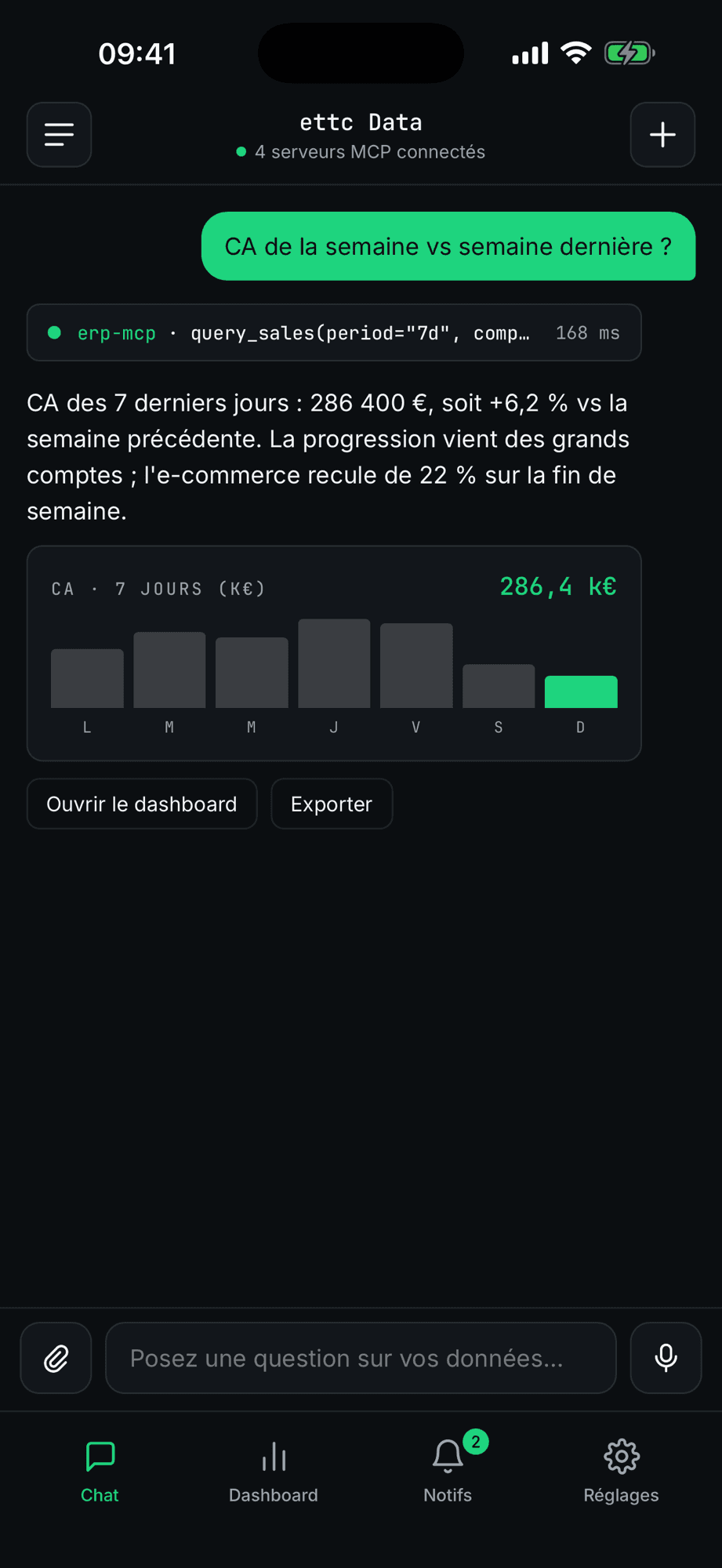
The grey line under the question is the query actually run against the warehouse, with its duration. The figure on screen comes straight from it.
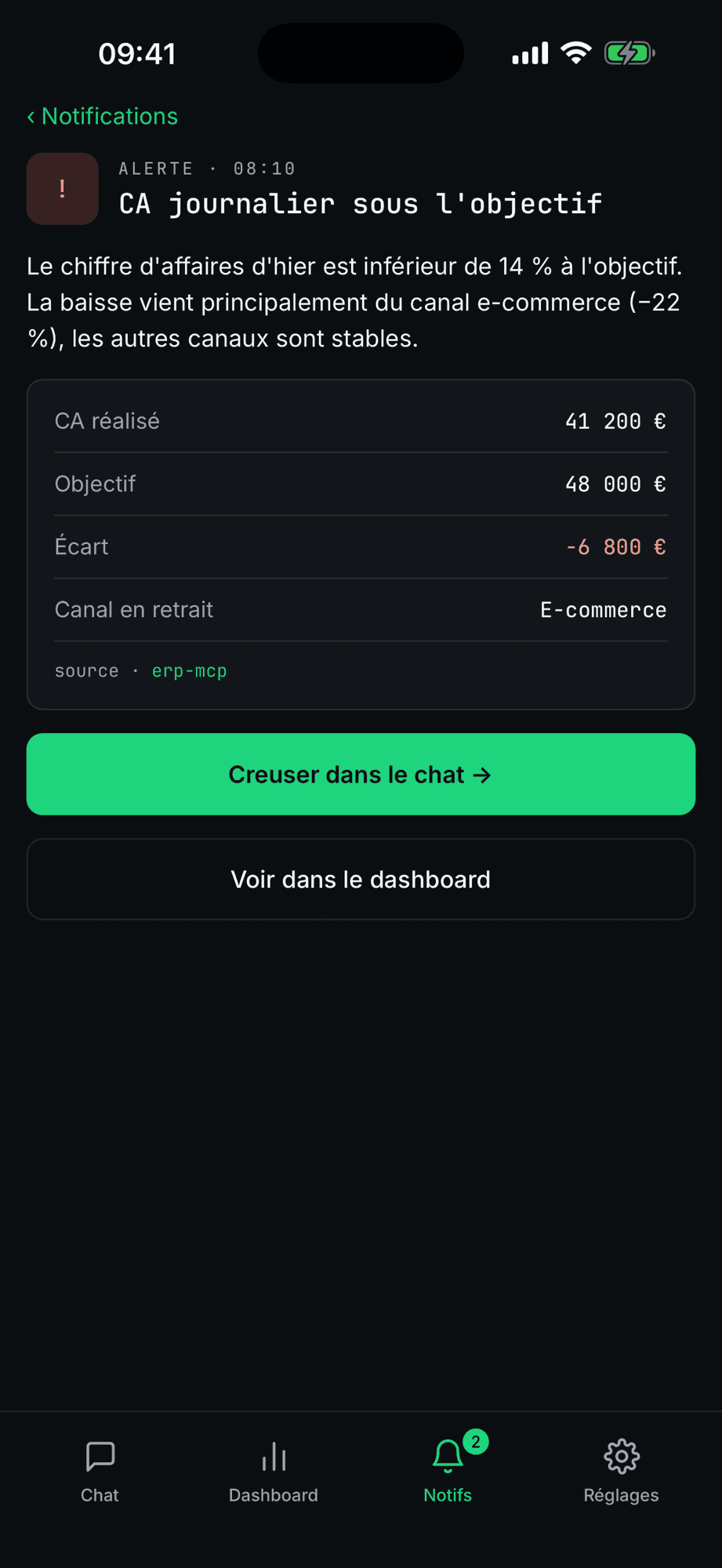
An alert does not just flag: it gives the gap, the likely cause, the source, and a way to dig in straight away.
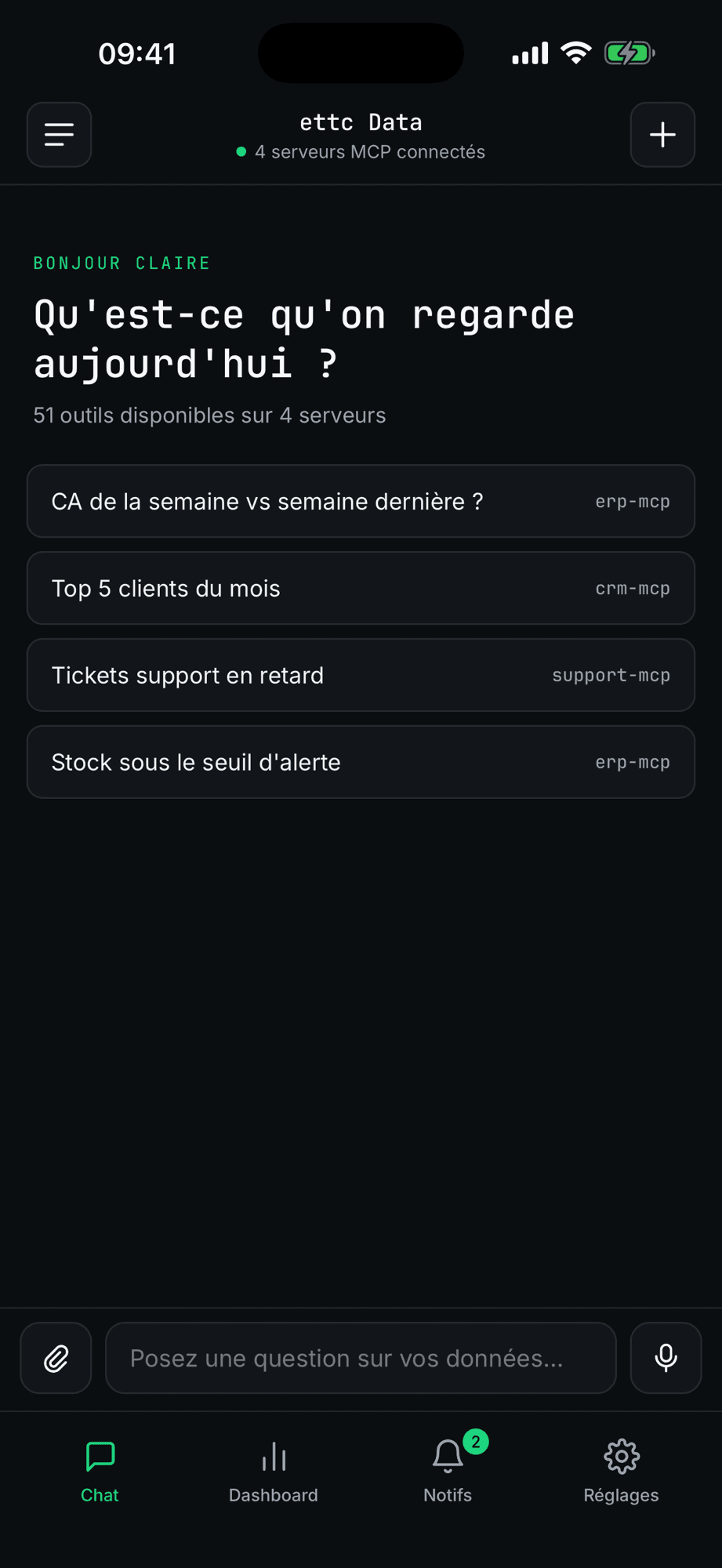
The scope is visible from the first screen: the questions covered, and the source answering each one.
How it is put in place
- 01a few days
A written scope
The list of questions covered, defined with you. Anything outside it gets an "I don't have that data" rather than an approximation. The scope is what protects your credibility.
- 021 to 2 weeks
Validated business calculations
Every question in scope is backed by a calculation written against the warehouse, reviewed and validated. The assistant picks the right one, it never improvises.
- 031 week
Guardrails and evaluation
A versioned set of scenarios measures answer fidelity before every release, alongside guardrails, retries and model fallback. We do not ship what we cannot measure.
- 04ongoing
Production and cost tracking
Web and mobile interface in your own colours, cost tracked per conversation, and the scope widened gradually as real usage reveals itself.
What you receive
- A written scope: what the assistant covers, and what it refuses to guess.
- The validated business calculations, versioned like the code.
- A replayable evaluation set, measuring answer quality at every change.
- The assistant on web and mobile, in your company's colours, for internal use.
- Inference cost tracking, per conversation and per month.
- An escalation procedure: what goes to a human, and to whom.
What makes an assistant fail
Trying to cover every question
An assistant meant to know everything gets it wrong in front of a user, and usage stops that same day. A narrow scope that holds beats broad, approximate coverage every time.
Plugging it in too early
On inconsistent data it answers wrong, confidently. That is why we never offer it before the foundation is reliable, even when the client asks for it.
No measurement
Without an evaluation set, nobody can say whether a change improves or degrades the answers. You then navigate on impressions, and quality decays without anyone noticing.
Price and timeline
Quoted case by case, after the foundation, depending on the breadth of the scope and the number of calculations to validate. Allow three to six weeks. The monthly inference cost is estimated before we start, then tracked in production.
The other engagements
The data audit
Two weeks at most, a fixed price, and a document that belongs to you. It is the only honest way to know what your data allows before committing a budget to it.
The data foundation
Four to eight weeks for your data to live in one place, historised and reliable. Delivered in usable stages, not in one go six months out.
Are your figures ready for an assistant?
Thirty minutes is enough to tell. If the foundation is not there, we will tell you that too.